
In this guide, you will get 25 practical brain exercises you can start today, plus a simple 7-day plan that takes 10 to 20 minutes a day. On Liftyolife, we focus on simple habits that protect brain health as you age.
- A quick top-10 list you can use right now
- A goal-based table to pick the right brain health exercises for you
- A beginner-friendly 7-day routine, plus safety tips and clear science expectations
Brain exercise: more than puzzles
Brain exercise can look like a puzzle, a dance class, a new recipe, or even a walk where you stay present and alert. The common thread is that you are practicing skills your brain uses every day, like memory, attention, processing speed, and executive function. Executive function is your brain’s “manager” for planning, switching tasks, and self-control.
If you want a shortcut, here it is: the best exercises for memory and concentration usually combine novelty plus repeat practice. And the best plan is the one you will actually keep doing.
This article is for information only, not medical advice. If you have new or worsening memory problems, confusion, or other concerning symptoms, talk with a clinician.
Top 10 brain exercises
If you want fast, practical brain exercises, start with these. They cover movement, learning, focus, and social connection, which is a more realistic mix than relying on one “magic” game.
- Brisk walking: Improves attention and mood, and is linked with brain-supporting factors like BDNF that help the brain adapt.
- Strength training: Trains full-body coordination and builds physical resilience that supports daily function and confidence as you age.
- Dance: Challenges memory, timing, balance, and cognitive flexibility while you learn new patterns and adjust on the fly.
- Tai chi: Builds balance and body awareness while requiring focus and step-by-step recall, a useful mix for older adults.
- Mindfulness meditation: Trains attention control by noticing distractions and returning focus, which can support stress regulation.
- Learning a new skill: Works memory and executive function through repetition, feedback, and gradual difficulty.
- Crossword or Sudoku: Practices word retrieval or logic, and helps you stay comfortable with effortful thinking.
- Jigsaw puzzle: Trains visual-spatial skills and patience, and is a low-stress way to practice sustained attention.
- Strategy games (chess or checkers): Builds planning and working memory as you think ahead and adapt to new moves.
- Social connection and communication: Exercises attention, memory for details, and emotional regulation through real-time interaction.
What is a brain exercise and do they work?
Definition: A brain exercise is any activity that challenges cognitive skills like memory, attention, and problem-solving through novelty, increasing difficulty, feedback, and consistency. The goal is not to “hack” your brain. It is to practice skills often enough that your brain gets more efficient at using them.
The main types of brain exercises
Different activities train different parts of cognition. Cognition is an umbrella term for how you think, learn, remember, and pay attention.
- Cognitive-only: puzzles, memory drills, logic problems
- Physical plus cognitive: dance, sports, dual-task training like walking while doing a mental task
- Social: conversation, clubs, volunteering, group classes
- Mind-body and stress regulation: mindfulness meditation, tai chi, breath work
- Lifestyle amplifiers: sleep quality, cardio fitness, stress management
A key point many people miss is that physical activity is also a brain health exercise. Research links aerobic exercise with cognitive benefits and with biological factors such as BDNF, a protein involved in brain plasticity and learning (see References).
What research can and can’t claim
Brain exercises tend to improve what you practice most. That is the good news. The more cautious news is that benefits do not always “transfer” perfectly into everyday life.
Works best when
- You practice multiple domains, like movement, learning, and attention
- You increase difficulty over time, not just minutes
- You get feedback, even simple feedback like “I remembered 8 items today, 10 next week”
- You stay consistent, because consistency beats intensity
Be cautious about
- Promises that one game will “prevent dementia” or “rewire your brain fast”
- Very long sessions that lead to burnout and quitting
- Assuming skill transfer is automatic, especially from app-based drills to daily life
A simple way to track progress
You do not need fancy testing. Try a weekly check-in:
- Energy and mood: Do you feel calmer, more alert, or less scattered?
- Adherence: How many days did you show up?
- Progression: Did the task get harder in a clear way?
- Daily function: Any small wins, like fewer missed appointments or better focus in meetings?
25 brain exercises you can do (pick by goal)
Below is a full list of brain health exercises you can mix and match. Each one includes what it trains, how to do it, time needed, and one way to level up.
Brain exercises by goal (chooser table)
Use this table to choose the best brain exercise based on your main goal and the time you have.
| Goal | Best picks | Time | Best for | Notes/cautions |
|---|---|---|---|---|
| Improve memory | Spaced recall, language | 10–20 min | Busy adults | Start easy, build reps |
| Improve focus | Pomodoro, mindfulness | 10–20 min | Distractible days | Reduce notifications |
| Faster thinking | Timed puzzles | 5–15 min | Quick sessions | Avoid frustration spiral |
| Flexibility | New routes, task switching | 5–20 min | Feeling “stuck” | Keep it safe outdoors |
| Reasoning | Chess, logic puzzles | 10–20 min | Strategic minds | Learn one concept weekly |
| Mood and stress | Walk intervals, tai chi | 10–20 min | High stress | Start low intensity |
| Brain plus body | Strength training | 15–30 min | Long-term aging | Use good form first |
| Social sharpness | Clubs, teach-back | 10–60 min | Loneliness risk | Schedule it weekly |
Memory builders (7)
1) Spaced recall practice
What it trains: Long-term memory and retrieval
How to do it:
- Learn 5 to 10 items like names, terms, or facts
- Test yourself after 10 minutes, 1 day, and 3 days
Time: 5–15 min
Make it harder: Increase the delay before you review
2) Learn a new language in small chunks
What it trains: Working memory and attention
How to do it:
- Learn 5 new words and use each in a sentence
- Review yesterday’s words before adding new ones
Time: 10–20 min
Make it harder: Speak out loud and record yourself
3) Learn a musical instrument or rhythm skill
What it trains: Memory, timing, and coordination
How to do it:
- Practice one short pattern daily
- Repeat slowly, then slightly faster
Time: 10–20 min
Make it harder: Play without looking at notes
4) Memory palace basics
What it trains: Visual-spatial memory and association
How to do it:
- Pick a familiar place like your home
- “Place” items along a route and mentally walk it
Time: 5–15 min
Make it harder: Use a new route or more items
5) Teach-back
What it trains: Understanding and recall
How to do it:
- Read or watch something short
- Explain it to a friend or voice note in your own words
Time: 5–15 min
Make it harder: Include one example and one counterpoint
6) Grocery list recall
What it trains: Everyday memory and chunking
How to do it:
- Look at a list of 8 to 12 items for 30 seconds
- Put it away and write what you remember
Time: 5–10 min
Make it harder: Group by category in your head first
7) Story retell
What it trains: Memory and sequencing
How to do it:
- Read a short article
- Retell the main points in order, then check accuracy
Time: 10–15 min
Make it harder: Retell again the next day
Focus and attention (6)
8) Pomodoro deep work
What it trains: Sustained attention
How to do it:
- Work 25 minutes on one task
- Take a 5-minute break, repeat once
Time: 30–60 min total, but start with one round
Make it harder: Shorten breaks and remove tabs
9) Mindfulness meditation
What it trains: Attention control and emotional regulation
How to do it:
- Sit comfortably and focus on breathing
- When your mind wanders, gently return to the breath
Time: 5–15 min
Make it harder: Practice with mild background noise
10) Single-task drills
What it trains: Focus and self-control
How to do it:
- Do one simple task like dishes or emails with no multitasking
- Notice when you reach for your phone and pause
Time: 5–20 min
Make it harder: Set the phone in another room
11) Dual-task walking, progressive
What it trains: Divided attention and coordination
How to do it:
- Walk an easy route and count backward by 1s or name animals
- Keep your pace safe and relaxed
Time: 10–20 min
Make it harder: Count backward by 3s, but slow down if needed
12) Reading with summaries
What it trains: Comprehension and working memory
How to do it:
- Read 2 to 3 pages
- Pause and write a 2-sentence summary
Time: 10–20 min
Make it harder: Summarize without looking back
13) Distraction delay
What it trains: Impulse control and focus
How to do it:
- When you want to check your phone, wait 60 seconds
- Write down what you were about to do, then return to it
Time: 5–10 min practice during the day
Make it harder: Increase delay to 3 minutes
Processing speed and cognitive flexibility (5)
Processing speed is how quickly you take in information and respond. Cognitive flexibility is how well you switch strategies when something changes.
14) Timed puzzles
What it trains: Speed plus accuracy under light pressure
How to do it:
- Set a timer for 5 minutes
- Do Sudoku, word search, or simple math
Time: 5–15 min
Make it harder: Use a slightly harder level, not double-hard
15) Reaction games, low-stakes
What it trains: Fast responses and attention
How to do it:
- Use a simple reaction-time test or coordination drill
- Keep sessions short and stop if you feel tense
Time: 5–10 min
Make it harder: Add a second rule like clap on red, tap on blue
16) Intentional task switching
What it trains: Cognitive flexibility and planning
How to do it:
- Pick two tasks like cleaning and paperwork
- Switch every 5 minutes on purpose, then return
Time: 10–20 min
Make it harder: Reduce switch time to 3 minutes
17) New routes and patterns
What it trains: Spatial memory and flexible thinking
How to do it:
- Take a different walking route or drive a new safe way
- Notice landmarks and recall them later
Time: 10–30 min
Make it harder: Plan the route from memory next time
18) Non-dominant hand practice
What it trains: Attention, coordination, and patience
How to do it:
- Brush teeth or stir coffee with your non-dominant hand
- Go slowly and stay safe
Time: 2–10 min
Make it harder: Write a short note, large letters only
Problem-solving and reasoning (4)
19) Chess or checkers with one learning goal
What it trains: Planning and working memory
How to do it:
- Play one short game
- Learn one pattern or principle, then replay
Time: 10–30 min
Make it harder: Analyze one mistake after each game
20) Logic puzzles
What it trains: Reasoning and persistence
How to do it:
- Choose a puzzle type you enjoy
- Solve slowly, and write down your steps
Time: 10–20 min
Make it harder: Explain your solution out loud
21) Budgeting and mental math
What it trains: Executive function and number sense
How to do it:
- Estimate grocery totals before checkout
- Do a weekly “where did money go” review
Time: 10–20 min
Make it harder: Use round numbers less and get more precise
22) Strategy video games, in moderation
What it trains: Planning, attention, and flexible strategies
How to do it:
- Choose a game that requires planning, not endless scrolling
- Set a firm stop time before you start
Time: 15–30 min
Make it harder: Increase difficulty only after you stay calm and consistent
Mood, stress, and brain-body (3)
Mood and stress strongly affect how well your brain performs today, even if your brain is healthy. These options support both mind and body.
23) Beginner-safe aerobic intervals
What it trains: Attention and mood support through cardio fitness
How to do it:
- Walk 2 minutes easy, 1 minute brisk, repeat 5 times
- Cool down 3 minutes
Time: 15–20 min
Make it harder: Add one more brisk round before adding speed
Note: Aerobic exercise is linked with increased BDNF in research reviews (see References).
24) Strength training fundamentals
What it trains: Coordination, confidence, and long-term brain-body support
How to do it:
- Do 1 to 2 sets each of squats to a chair, wall pushups, and rows
- Rest as needed and focus on smooth form
Time: 15–25 min
Make it harder: Add a third set or slower lowering phase
25) Tai chi or dance practice
What it trains: Balance, memory for sequences, and stress relief
How to do it:
- Follow a short beginner routine and repeat it
- Focus on slow, controlled movement
Time: 10–20 min
Make it harder: Learn a new sequence and combine them
7-day brain exercise plan (10–20 minutes/day)
This 7-day plan is for beginners, busy adults, or anyone restarting after a break. Each day includes movement, a mental challenge, and a small recovery habit. If you are making a big change to your activity level or you have balance issues, consider medical clearance first.
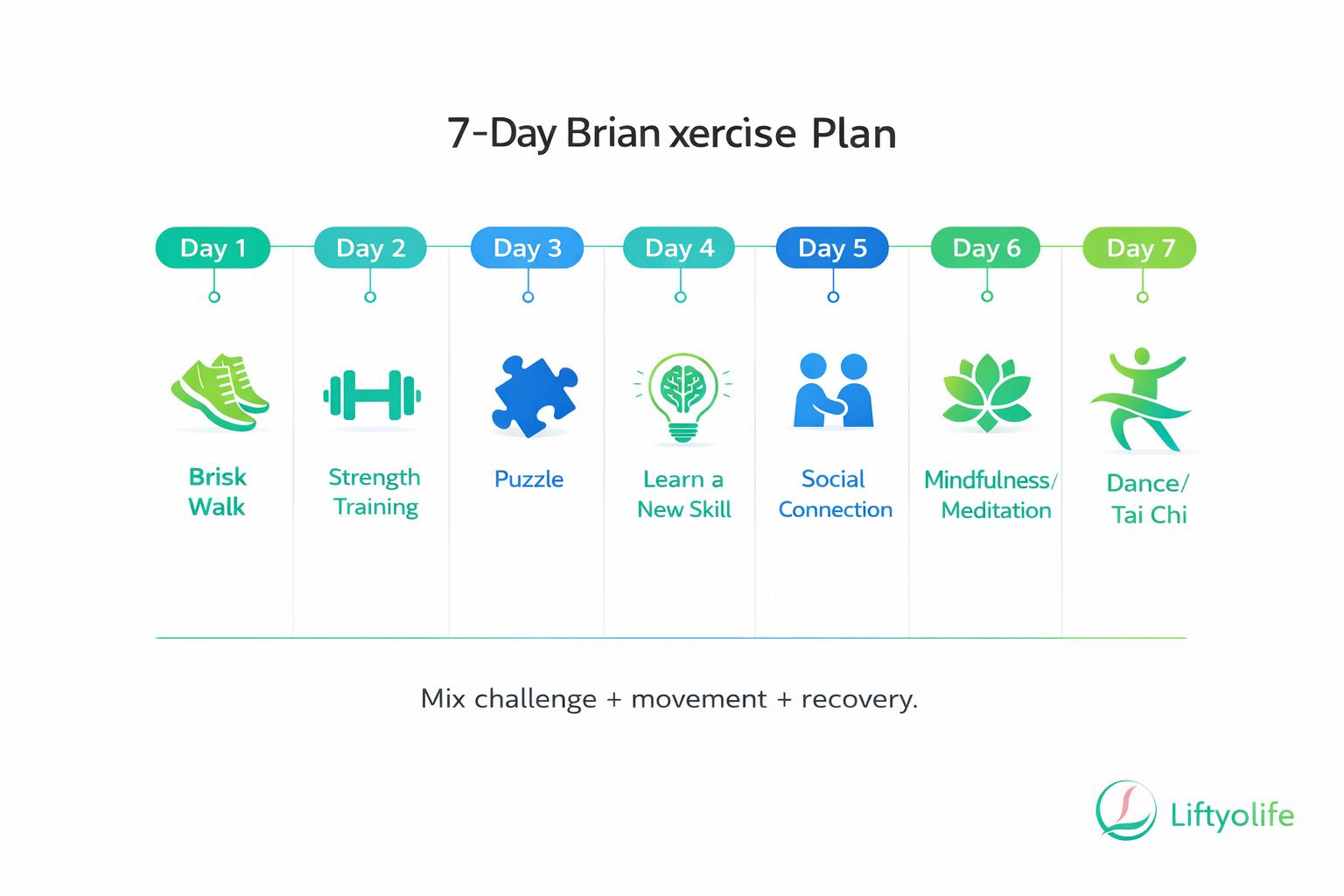
- Day 1
- Movement: Brisk walk 10 minutes
- Mental challenge: Easy Sudoku or crossword 5 minutes
- Recovery: Pick a bedtime cue like dim lights 30 minutes early
- Day 2
- Movement: Basic strength routine 15 minutes
- Mental challenge: Grocery list recall, 2 rounds
- Recovery: 5 slow breaths before sleep
- Day 3
- Movement: Learn 5 to 10 minutes of dance steps
- Mental challenge: Repeat the steps without watching once
- Recovery: 5-minute mindfulness practice
- Day 4
- Movement: Light walk 10 minutes
- Mental challenge: Learn a language phrase set for 10 minutes
- Recovery: Write one sentence about what you learned
- Day 5
- Movement: Short walk or easy mobility 10 minutes
- Mental challenge: Crossword 10 minutes
- Recovery: Social activity, even a 10-minute call
- Day 6
- Movement: Tai chi or balance practice 10 minutes
- Mental challenge: Strategy game 10 minutes
- Recovery: Screen off 20 minutes before bed
- Day 7
- Movement: Choice day, walk, strength, or dance
- Mental challenge: Choice day, puzzle or learning
- Recovery: 5-minute reflection, what felt easiest to repeat?
Progression for weeks 2 to 4
Add difficulty first, then time. In practice, that means:
- Choose harder puzzles, not longer sessions
- Learn new choreography or a new tai chi sequence
- Walk a little faster, or add one extra brisk interval
- Use fewer hints and rely more on recall
If you only do one thing, do 10 minutes of movement plus 10 minutes of learning most days. That combination is simple, realistic, and easy to build on.
Brain training apps vs. offline exercises
Brain training games can be useful, but they are not the whole story. A well-known consensus review found that brain-training programs usually improve performance on trained tasks, while transfer to broader daily-life skills is often limited (Simons et al., 2016, see References).
Pros
- Easy to do consistently because sessions are short
- Clear feedback like levels and scores
- Good for specific drills like working memory or speed
Cons
- Real-life transfer can be modest, especially if you only train one type of task
- Screen time can displace sleep, movement, and social time
- It is easy to plateau if the challenge does not progress
Best practices
- Use apps as a supplement, not your entire brain exercise plan
- Choose programs with progression, not just repetition
- Keep sessions short, 5 to 15 minutes, then stop
- Pair with movement and recovery habits, such as a walk and a consistent bedtime
- If you want movement ideas that fit busy weeks, see these 20-minute workouts
Safety tips and when to talk to a clinician
Most brain exercises are low risk, but safety matters more as you age or if you have balance, vision, or memory concerns. Start easier than you think you need to, then build.
If you are worried about mild cognitive impairment or dementia, involve a clinician and consider bringing a family member. Keep routines simple, repeat familiar activities, and focus on enjoyment and consistency.
Seek urgent care if you notice sudden or severe symptoms such as:
- Sudden confusion or trouble speaking
- Sudden weakness or numbness, especially on one side
- Sudden vision changes or trouble walking
- A sudden, severe headache that feels unusual
These can be warning signs of serious conditions like stroke. The CDC lists FAST warning signs and other symptoms to watch for (see References).
Key takeaways
- Brain exercise includes mental, physical, and social activities, not just puzzles.
- The best plan mixes domains like movement, learning, and attention practice.
- Practice improves what you train most, but everyday transfer varies.
- Aim for 10 to 20 minutes most days, and increase difficulty gradually.
- If symptoms feel sudden or concerning, talk to a clinician right away.
If you want to support the brain-body side of this plan, a steady cardio habit helps. This guide on cycling calories in 30 minutes can help you plan realistic movement sessions.
Frequently Asked Questions
What is a brain exercise?
A brain exercise is any activity that challenges thinking skills like memory, attention, and problem-solving. It can be mental like puzzles, physical plus cognitive like dance, or social like conversation. The best option is the one you will do consistently.
What is the best brain exercise for memory?
Learning something new, like a language or music, is a strong memory challenge, especially with spaced practice. Combining movement plus thinking, such as dual-task walking, can also help. Consistency matters more than picking the perfect activity.
Do brain training apps actually work?
They can improve performance on the specific tasks you practice. Transfer to daily life skills varies and is often modest. Use them as one tool alongside movement, sleep, and social activity.
How many minutes a day should I do brain exercises?
Aim for 10 to 20 minutes most days for cognitive challenges. Pair that with regular aerobic activity and two days per week of strength work for brain-body benefits. Start small and increase difficulty gradually.
Can brain exercises prevent dementia?
No single activity is proven to prevent dementia for everyone. But staying active physically, mentally, and socially is linked with better brain health as you age. If you have concerning symptoms, talk with a clinician.
What are good brain exercises for seniors?
Walking, tai chi, dance, simple strength training, puzzles, and social activities are great options. Choose low fall-risk activities and progress slowly. Consider medical guidance if balance, vision, or memory problems are present.
References
- Physical Activity Guidelines for Americans, 2nd edition – US guidance on aerobic and strength activity for adults and older adults.
- CDC Physical Activity Guidelines for Adults – Plain-language summary of weekly activity targets.
- Aerobic exercise and cognition review – Review of how aerobic exercise relates to executive function, attention, and memory.
- Meta-analysis: exercise increases BDNF – Evidence that acute and chronic aerobic exercise can raise BDNF levels.
- Do “Brain Training” Programs Work? Simons et al. (2016) – Consensus review on benefits and limits of brain-training transfer.
- CDC Stroke Signs and Symptoms – FAST warning signs and additional symptoms that need urgent attention.
Brain exercise works best when it is varied, progressive, and easy to repeat. Pick one movement option, one thinking challenge, and one recovery habit, then do it often enough that it becomes automatic. Over time, those small sessions can add up to better focus, steadier mood, and more confidence in everyday life.