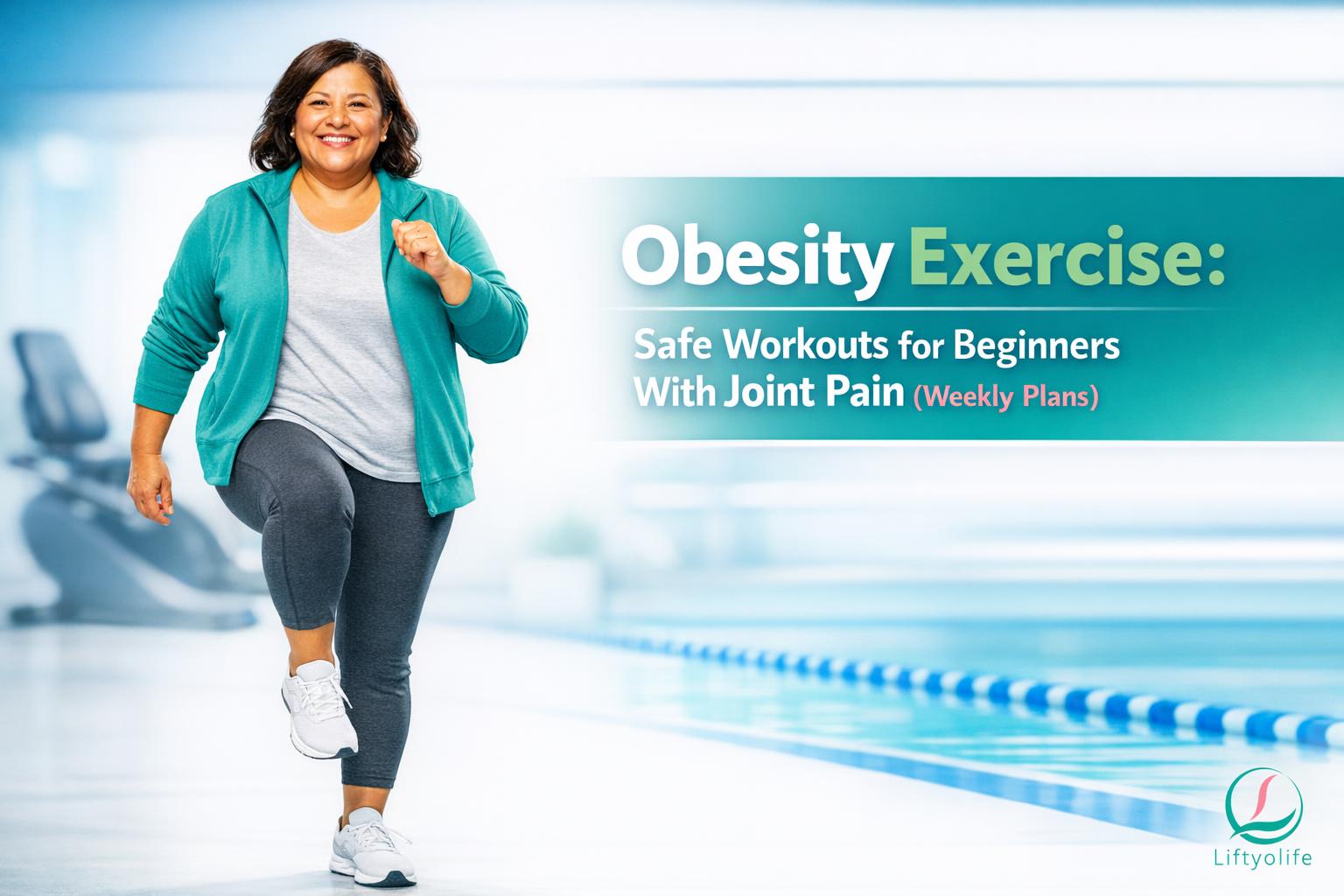
Starting obesity exercise can feel intimidating if your knees hurt, your back is stiff, or you get out of breath fast. The most effective place to begin is usually the safest one: low-impact movement you can repeat without a pain flare.
At Liftyolife, this guide focuses on practical, joint-friendly steps: a low-impact workout menu, a safety checklist, and three weekly plans you can follow right away. Often misspelled “obesity excercise,” this is the same topic, safe exercise for adults with obesity who want a realistic plan.
- Start with 5 to 10 minutes if that is all you have today.
- Build minutes first, then speed or resistance later.
- Add strength twice a week to support joints and daily life.
Why obesity can make exercise harder
“Obesity” is a medical term that often means a BMI of 30 or higher. BMI is a simple height to weight calculation. It is useful as a screening tool, but it has limits since it does not measure muscle, bone density, or where fat is stored.
If exercise feels harder right now, there are real reasons. None of them are moral failures. Most improve with consistent, joint-friendly activity and a gradual progression.
Common reasons workouts feel tougher
- Higher joint load: More bodyweight can increase stress through knees, hips, ankles, and feet with each step.
- Osteoarthritis risk: Extra load plus old injuries can contribute to knee or hip osteoarthritis over time.
- Deconditioning: If you have been less active, your heart, lungs, and muscles need time to adapt.
- Sleep apnea and poor sleep: Low-quality sleep can raise fatigue and reduce recovery.
- Blood pressure or blood sugar issues: Hypertension and type 2 diabetes can affect exercise tolerance and recovery.
- Heat intolerance: A larger body can hold heat longer, so workouts feel harder in warm rooms.
The goal of exercise for obesity is bigger than the scale. It is about improving stamina, reducing pain, protecting independence, and improving health markers like blood pressure and glucose. Weight change often follows, but function usually improves first.
How much exercise do you need for obesity?
Most adults benefit from building toward 150 minutes per week of moderate aerobic activity, plus strength training at least 2 days per week. For extra health benefits, guidelines support working up to 300 minutes per week. For more noticeable fat loss or preventing regain, many people need 225 to 300+ minutes per week, along with nutrition changes.
According to the CDC and the Physical Activity Guidelines for Americans, adults should aim for at least 150 minutes a week of moderate-intensity activity or 75 minutes vigorous, plus muscle strengthening 2 or more days per week (CDC, U.S. DHHS).
- For general health: 150 min per week moderate, or 75 min vigorous
- For additional benefits: up to 300 min per week moderate
- For more weight loss or preventing regain: often 225 to 300+ min per week for many people
- Strength training: 2+ days per week, full body
How to tell your intensity without gadgets
- Moderate intensity: you can talk in short sentences, but you would not want to sing. About 5 to 6 out of 10 effort.
- Vigorous intensity: you can say only a few words before you need a breath. About 7 to 8 out of 10 effort.
If you can only do 5 minutes, start there. Consistency turns small sessions into real weekly totals.
3 rules to start exercising safely with joint pain
Starting safely is not about pushing through pain. It is about choosing the least painful option, doing a manageable dose, and repeating it often enough to adapt.
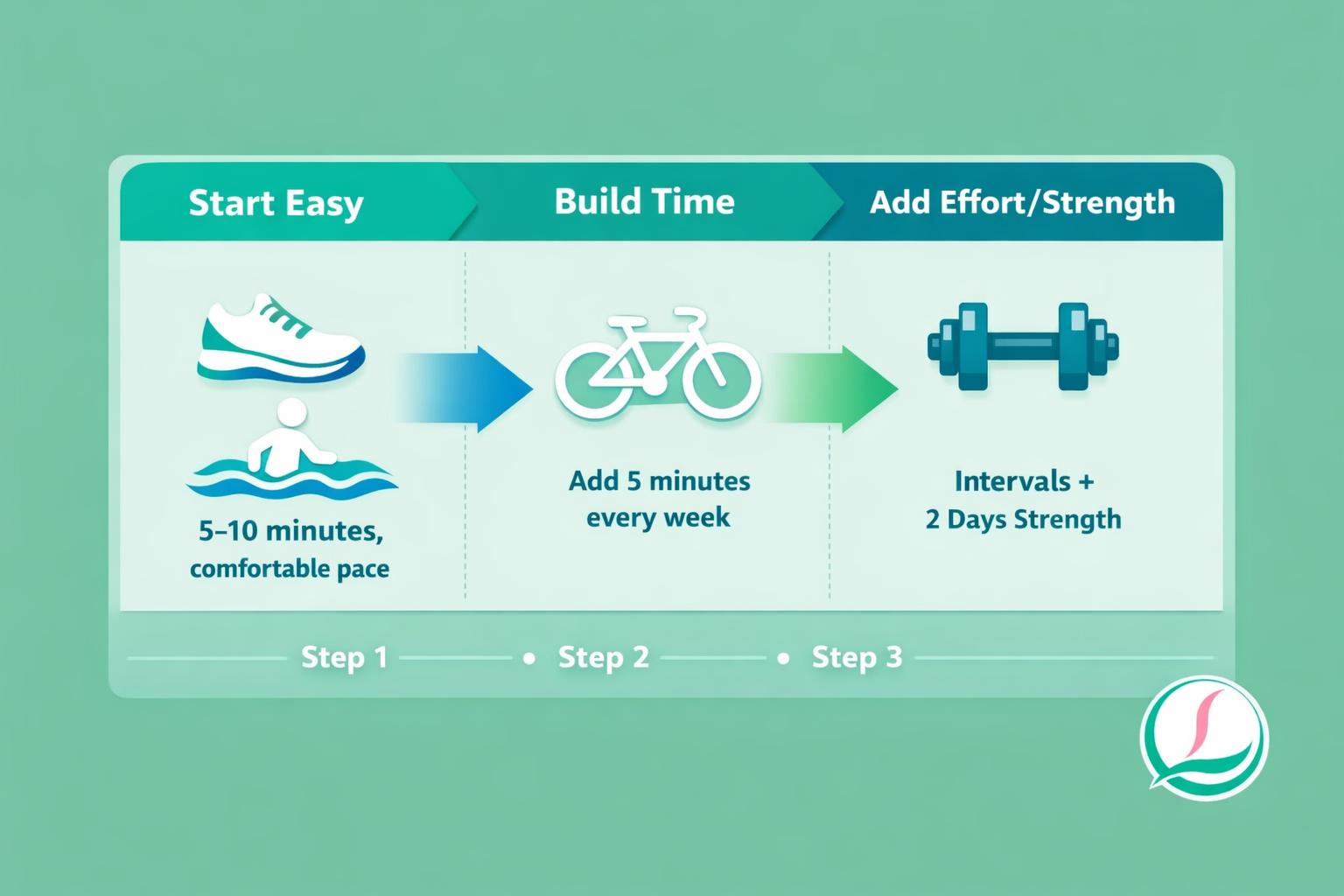
3-step low-impact exercise progression for obesity and joint pain
- Start low-impact. Pick flat walking, cycling, water exercise, elliptical, or chair cardio to reduce pounding and flare-ups.
- Build time before intensity. Add minutes first, not speed. A useful guide is 5 to 10 percent more total weekly time, or just 2 to 5 minutes added to a couple sessions each week.
- Add strength to support joints. Strong glutes, thighs, calves, and core help stabilize knees, hips, and back. Two short strength days per week is enough to start.
Pain scale guide
- 0 to 2: mild discomfort, usually okay to continue.
- 3 to 4: noticeable pain, modify by slowing down, shortening, or switching modes.
- 5+: stop for the day and reassess your plan.
A practical rule: discomfort that settles back to normal within 24 hours is often acceptable. Pain that spikes during the session, causes limping, or stays worse for more than a day is a sign to back off.
Safety first: when to get medical clearance
Most people can begin with light activity safely. But if you have certain conditions or symptoms, it is smart to talk with a clinician before starting or before increasing intensity, especially if you want to do vigorous workouts.
Get medical advice before starting if you:
- Have known heart disease, heart failure, or a history of stroke
- Have chest pain or pressure at rest or with activity
- Get severe shortness of breath that feels out of proportion
- Have uncontrolled high blood pressure
- Have diabetes with complications such as nerve damage, kidney disease, or eye disease
- Have symptoms of severe sleep apnea, such as loud snoring plus choking or gasping at night and significant daytime sleepiness
- Had recent surgery, a recent hospitalization, or an unstable medical condition
- Have severe mobility limits, frequent falls, or you feel unsafe walking
Stop and get help if you:
- Feel chest pain, tightness, or pressure
- Faint, or feel like you might faint
- Have severe dizziness, confusion, or sudden weakness
- Notice a new or fast irregular heartbeat
- Have severe shortness of breath that does not improve with rest
- Develop sudden, marked joint swelling or you cannot bear weight
- Get calf pain with swelling, warmth, or redness, which can be a warning sign for a blood clot
For a simple self-check, you can use a PAR-Q style questionnaire or the ACSM preparticipation screening approach (ACSM). If you answer yes to symptoms, consider starting with a physical therapist, a clinical exercise professional, or a supervised program.
Best low-impact cardio for obesity
You do not need to run to improve fitness. The best low impact exercise for obesity is the one that gets your breathing up without punishing your joints.
Simplest: walking
Why it helps: Walking is accessible, improves aerobic fitness, and can reduce stiffness when done in short bouts.
How to start: Start with 5 to 10 minutes, 3 to 5 days per week. If you like step goals, treat them as a bonus. Build minutes first.
Joint-pain modification: Choose flat, even surfaces. Wear supportive shoes. Try two or three short walks spread through the day instead of one longer session.
Stationary or recumbent bike
Why it helps: Cycling is low impact and often better tolerated with knee or hip osteoarthritis because it reduces repetitive bodyweight impact.
How to start: 8 to 15 minutes at easy resistance, 3 days per week.
Joint-pain modification: Set the seat so your knee has a slight bend at the bottom of the pedal stroke. If the front of the knee hurts, raise the seat slightly and reduce resistance.
Swimming or water aerobics
Why it helps: Water buoyancy unloads joints, so you can often move longer with less pain. This is a method highly recommended for weight loss starters from doctors and athletes
How to start: 20 to 30 minutes in a beginner class, 1 to 3 days per week. Water walking in the shallow end counts too.
Joint-pain modification: Choose water walking, gentle flutter kicks holding the wall, or easy laps. Keep movements smooth.
Elliptical
Why it helps: The elliptical provides steady cardio with low impact, often easier than fast walking for some people.
How to start: 5 to 12 minutes, low resistance, upright posture.
Joint-pain modification: If knees flare, reduce stride length and resistance. Hold fixed handles if balance feels uncertain.
Chair cardio
Why it helps: Chair cardio is a safe bridge if walking hurts or balance feels shaky. It is also a solid at-home option.
How to start: Do 30 seconds on, then 30 to 60 seconds easy, for 6 to 10 rounds. Total time 6 to 12 minutes.
Joint-pain modification: Keep feet flat for most moves and avoid twisting through painful hips or knees.
10-minute joint-friendly cardio circuit (pick 4, repeat twice)
- Seated march, 45 seconds
- Seated punches, 45 seconds
- Seated step taps, 45 seconds
- Sit-to-stand to a high chair, 6 to 10 reps
- Wall-supported side steps, 45 seconds
- Easy recovery, 60 seconds between rounds
For more seated options you can scale up or down, use this chair exercise routine and keep your effort in a comfortable moderate zone.
Low-impact exercise comparison
| Exercise mode | Joint impact | Best for | How to progress |
|---|---|---|---|
| Walking | Low to medium | Most beginners | Add minutes first |
| Recumbent bike | Very low | Knee or hip pain | Add time, then resistance |
| Water exercise | Very low | Arthritis, high pain | Add time, then effort |
| Elliptical | Low | When walking hurts | Add minutes slowly |
| Chair cardio | Very low | Low fitness, balance | Add rounds, then speed |
If one option causes a pain flare, switch to a lower-impact option for two weeks and rebuild consistency there. Over time, rotating modes can reduce repeat stress on the same joints.
Strength training for obesity
Strength training helps you keep or build muscle, support joints, and improve daily function. It also supports metabolic health, including insulin sensitivity, which matters for many people with obesity and type 2 diabetes risk. Major guidelines recommend muscle-strengthening activities at least 2 days per week (CDC, WHO).
Beginner default that works for most people
- Frequency: 2 days per week
- Sets and reps: 1 to 2 sets of 8 to 12 reps
- Effort: stop with 2 to 3 reps left in the tank
- Rest: 60 to 90 seconds between sets
- Range of motion: pain-free and controlled
Beginner moves with simple modifications
- Sit-to-stand: thighs and hips. Easier: higher seat, use hands. Harder: hold light weights.
- Wall push-up: chest, shoulders, arms. Easier: hands higher. Harder: hands lower or countertop.
- Seated row with band: upper back posture support. Easier: lighter band. Harder: pause and squeeze.
- Glute bridge: glutes and back support. Easier: smaller range. Harder: pause at top.
- Low step-up: legs and balance. Easier: lower step, hold a rail. Harder: slow tempo.
- Farmer carry: core, grip, posture. Easier: shorter distance. Harder: slightly heavier weights.
- Supported calf raises: ankles and walking endurance. Easier: smaller range. Harder: one leg at a time.
- Dead bug or standing core brace: trunk stability. Easier: standing brace. Harder: slow dead bug reps.
If your knees are sensitive, keep the movement smaller and slower and stay in a pain-free range. If you want a deeper explanation of why lifting helps during fat loss, see this section on strength training for weight loss.
3 weekly exercise plans for obesity
Pick the plan that feels almost too easy in week 1. That is usually the right move. You can always add later. Pain flare-ups and burnout usually happen when you start too hard.
Plan A (very deconditioned or 100+ pounds overweight): micro-sessions
| Day | Activity | Minutes |
|---|---|---|
| Mon | 2 short walks or chair cardio | 5 + 5 |
| Tue | Strength A, easy full body | 15 |
| Wed | Easy bike or water walking | 10 |
| Thu | Chair cardio | 8 |
| Fri | Strength B, repeat basics | 15 |
| Sat | Optional easy walk | 10 |
| Sun | Rest + gentle mobility | 5 |
Plan B (standard beginner): build toward 150 minutes per week
| Day | Activity | Minutes |
|---|---|---|
| Mon | Walk or bike, moderate | 20 |
| Tue | Strength, full body | 25 |
| Wed | Walk, easy to moderate | 25 |
| Thu | Rest or gentle mobility | 10 |
| Fri | Walk or elliptical, moderate | 20 |
| Sat | Strength, full body | 25 |
| Sun | Longer easy walk | 30 |
Plan C (knee or hip pain focus): bike, water, chair emphasis
| Day | Activity | Minutes |
|---|---|---|
| Mon | Recumbent bike, easy | 15 |
| Tue | Strength, seated or supported | 20 |
| Wed | Water aerobics or water walking | 25 |
| Thu | Chair cardio intervals | 10 |
| Fri | Recumbent bike, moderate | 15 |
| Sat | Strength, repeat + calf raises | 20 |
| Sun | Rest or gentle range of motion | 10 |
How to progress without flare-ups
- Add 5 to 10 total minutes per week, or add 2 to 5 minutes to two sessions.
- If pain flares, hold steady for a week or take a lighter week and build again.
What if I miss a day? Do not double up. Just do the next planned session. The streak is built by returning, not by punishment workouts.
Common obstacles
- Problem: I get hungrier after workouts. Fix: plan a protein and fiber meal within 2 hours and keep a planned snack ready.
- Problem: I feel self-conscious exercising. Fix: start at home, walk in quieter areas, or go to the gym at off-peak hours.
- Problem: Pain flares derail my week. Fix: switch to bike or water for 1 to 2 weeks and reduce total minutes.
- Problem: I lose motivation fast. Fix: track minutes, not miles, and pair workouts with music or a podcast you enjoy.
- Problem: I am too busy. Fix: use two 5-minute movement snacks after meals and count them as real training.
- Problem: I feel like I failed when I miss sessions. Fix: use the rule “never miss twice” and restart with an easier dose.
- Problem: I get bored. Fix: rotate two cardio modes and two strength routines so your week feels fresh.
- Problem: I do too much on good days. Fix: cap your session at the planned time and save progress for next week.
Frequently Asked Questions
What is the best exercise for obesity?
The best exercise is the one you can do consistently without pain, which is often walking, cycling, or water exercise. Start low-impact and build weekly minutes first, then add intensity later. Pair cardio with strength training twice a week for better function and body composition.
How many minutes a day should an obese person exercise?
For health, aim toward 150 minutes per week, often around 20 to 30 minutes a day. For more weight loss or preventing regain, many people need 225 to 300+ minutes per week, plus nutrition changes. If you are very deconditioned, start with 5 to 10 minutes and build up.
Is walking enough to lose weight with obesity?
Walking can work, especially if you increase weekly minutes gradually. Weight loss tends to improve with higher weekly volume, often 225+ minutes per week, plus a sustainable calorie deficit. Later you can add gentle intervals or hills if your joints tolerate it.
What exercises should I avoid if I have knee pain and obesity?
Avoid high-impact jumping and running at first if they worsen pain. Start with cycling, water exercise, elliptical, or short flat walks and keep intensity moderate. Stop and get assessed if pain is sharp, swelling increases, or your knee feels unstable.
How do I start exercising if I’m 100 pounds overweight?
Start with short low-impact sessions of 5 to 10 minutes and build weekly. Use chair or water options if walking hurts and aim for consistency 3 to 5 days per week. Add strength training twice weekly once the habit feels stable.
Does exercise increase hunger when you’re trying to lose weight?
It can, especially as sessions get longer. Protein and fiber at meals, planned snacks, hydration, and better sleep help control appetite. Track hunger patterns for two weeks and adjust meal timing and portions based on what you see.
References
- CDC Physical Activity Guidelines for Adults – Recommended weekly minutes and strength training guidance.
- Physical Activity Guidelines for Americans, 2nd edition – U.S. guidance on activity dose and intensity.
- WHO Physical Activity – Global recommendations and benefits of higher volumes.
- Donnelly et al. Physical activity strategies for weight loss and prevention of weight regain – Dose ranges commonly cited for weight loss and maintenance support.
- Updating ACSM recommendations for exercise preparticipation health screening – Evidence and rationale for modern screening approaches.
- ACSM Preparticipation Screening Guidelines PDF – Screening framework and symptom-based referral guidance.
Safe obesity exercise starts with low-impact cardio you can repeat, strength training twice a week, and a weekly plan that increases minutes slowly. If you choose the least painful option today and progress in small steps, your stamina and joint comfort often improve before the scale changes.