

Morning Wellness Routine (Without Waking Up Earlier)
Most people do not skip mornings because they do not care. They skip them because mornings feel like a sprint: stiff joints, a loud mind, a packed calendar, and a phone that starts demanding attention before your feet hit the floor. The fix is not an extreme schedule. It is a healthy morning routine that fits the life you already have.
This guide from Liftyolife is built to be practical, flexible, and realistic for adults who want more energy and less chaos.
What you’ll get:
- A simple 9-step morning routine you can repeat
- Done-for-you 5/15/30/60-minute templates (with minute-by-minute timing)
- A one-screen morning routine checklist you can screenshot
Jump to what you need:
- What is a morning wellness routine?
- Pick your time: 5, 15, 30, or 60 minutes
- The best routine: 9 simple steps
- Copy/paste templates
- Comparison tables
- Mistakes + fixes
- Safety notes
- Checklist
- 7-day ramp plan
- Sources and standards
What Is a Morning Wellness Routine?
A morning wellness routine is a short, intentional set of habits you do after waking to support steadier energy, mood, and focus. The best routines are simple and repeatable, and they usually include light exposure, hydration and nutrition, gentle movement, a mindset reset, and a quick plan for the day.
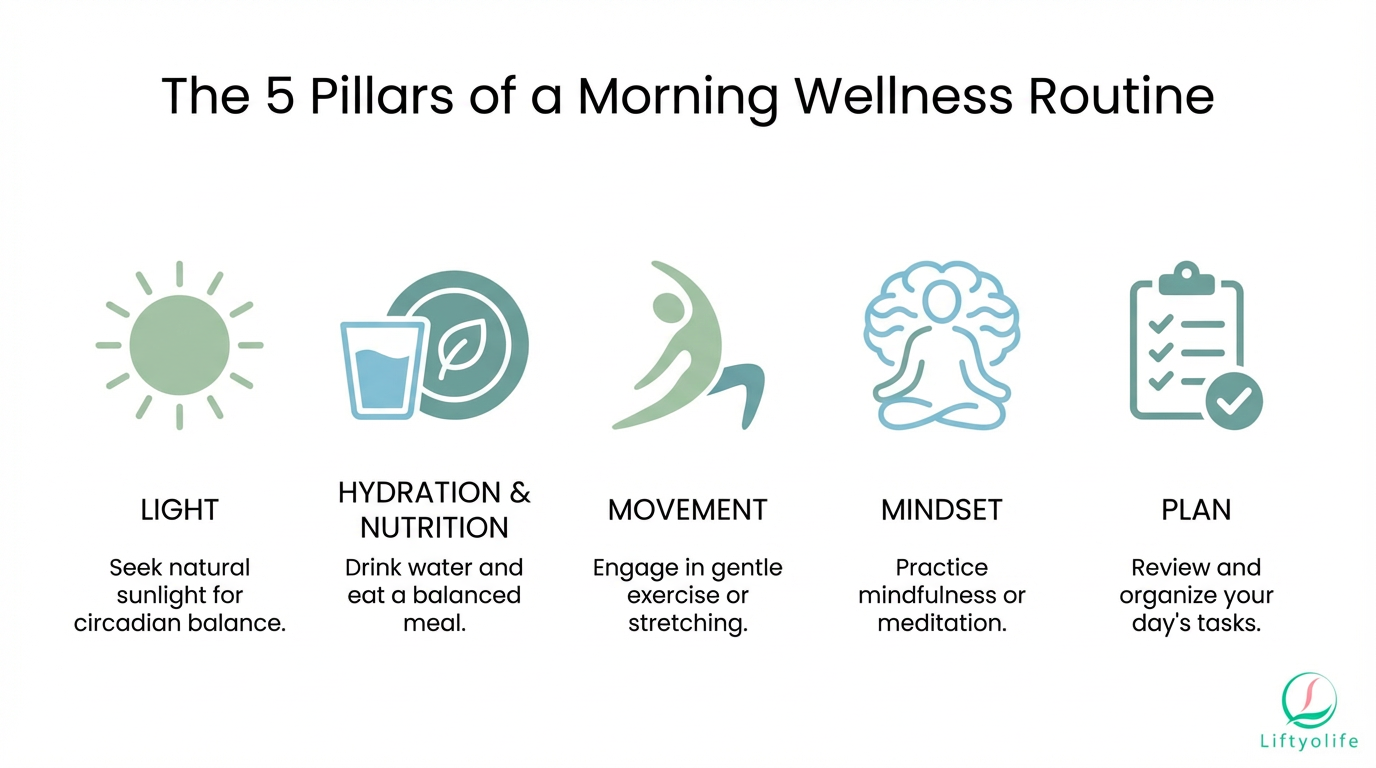
Here are the five pillars that make a routine feel “wellness-based” (not just busy):
- Light: Bright light soon after waking helps set your body clock (circadian rhythm).
- Hydration/Nutrition: Water first, then a simple breakfast plan (or a smart delay) to avoid crashes.
- Movement: Gentle mobility and light activity to reduce stiffness and wake up your body.
- Mindset: Breathing, meditation, or journaling to lower mental noise.
- Plan: One small planning step so your day feels directed, not reactive.
In plain language, your body uses light and a consistent wake time to “set the clock” that influences sleep, alertness, and appetite. Many people also notice a natural bump in alertness after waking called the cortisol awakening response, which peaks roughly 30 to 45 minutes after you wake (NCBI).
Pick Your Time: 5, 15, 30, or 60 Minutes
You do not need the “perfect” routine. You need the one you will actually do on an average Tuesday.
- 5 minutes: Best for parents, commuters, caregivers, or anyone rebuilding consistency. Outcome: you start less dehydrated and more grounded.
- 15 minutes: Best for most people. Outcome: a balanced morning routine for energy without feeling rushed.
- 30 minutes: Best if you want noticeable mobility and mood benefits. Outcome: you feel warm, loose, and clearer.
- 60 minutes: Best if mornings are your main self-care window. Outcome: exercise, real breakfast, and planning time.
Start with the 5-minute version for 7 days. Once it feels automatic, you can upgrade by adding 5 minutes at a time.
Jump to templates:
The Best Morning Wellness Routine (9 Simple Steps)
If you want one default routine you can use most days, follow this order. It builds from “wake your body up” to “aim your day.” If you only have a few minutes, do the early steps and stop.
- Wake up without the snooze spiral (30 seconds).
- Do: Use a “feet on floor” rule. Put your phone or alarm across the room so you have to stand up.
- Why: Snoozing can fragment your final sleep and make the morning feel like a negotiation.
- Quick modification: If you share a room, try a vibration alarm or a sunrise alarm light.
- Get bright light (2-10 minutes).
- Do: Step outside for 2-10 minutes, or sit by a bright window. If it is dark, turn on bright indoor lights.
- Why: Morning light helps anchor your circadian rhythm and can make it easier to feel sleepy at night (Sleep Foundation, NCBI).
- Quick modification: On cloudy days, stay outside a bit longer.
- Hydrate (1 minute).
- Do: Drink 8-16 oz (250-500 ml) of water.
- Why: You lose water overnight through breathing and sweat. Hydration in the morning can reduce that “draggy” feeling.
- Quick modification: Electrolytes vs water: consider electrolytes if you sweat heavily, train early, work in heat, or wake with headaches. Otherwise, plain water is usually enough.
- 2-5 minutes of gentle mobility (2-5 minutes).
- Do: Move your neck, shoulders, hips, and spine through comfortable ranges.
- Try this quick sequence:
- 5 slow neck turns each side
- 10 shoulder circles
- 5 cat-cows
- 5 hip hinges (hands on thighs)
- Why: A simple morning stretch routine reduces stiffness and tells your body, “we are awake.”
- Quick modification: If your back is sensitive, do cat-cow standing with hands on a counter.
- 1-3 minutes of breathing (1-3 minutes).
- Do: Pick one option:
- Box breathing: inhale 4, hold 4, exhale 4, hold 4 (repeat 4 times)
- Diaphragmatic breathing: one hand on belly, slow nasal inhale, longer exhale
- Why: Slow breathing can shift you out of “rush mode,” especially if you wake anxious.
- Quick modification: If counting stresses you, simply make your exhale longer than your inhale.
- Do: Pick one option:
- Short movement (3-20 minutes).
- Do: Choose one: brisk walk, easy strength circuit, short yoga flow, or a bike ride.
- Why: Light movement supports circulation, joint lubrication, mood, and mental energy. Outdoor movement also increases light exposure, which reinforces your body clock (NCBI).
- Quick modification: Knee pain? Walk flat routes, reduce pace, or use a stationary bike.
- Hygiene + “reset your space” (3-10 minutes).
- Do: Brush teeth, wash face, shower, and do one small reset (make bed, clear a counter).
- Why: This creates a clean cue that your day has started and reduces visual clutter.
- Quick modification: If you are rushed, make the bed only. It still works as a mental reset.
- Breakfast (or smart delay) (5-20 minutes).
- Do: If you eat, aim for protein + fiber.
- Easy breakfast examples:
- Greek yogurt + berries + chia or flax
- Eggs + spinach + whole-grain toast
- Oatmeal + nut butter + seeds (add yogurt or milk for more protein)
- Why: Protein and fiber tend to improve fullness and can smooth energy and cravings later.
- Quick modification: If you prefer a later breakfast, hydrate first and plan a protein option for later (for example, a yogurt cup, cottage cheese, or a simple smoothie).
- 3-minute plan (3 minutes).
- Do: Write:
- Your top 3 tasks (today’s “musts”)
- One health action (walk at lunch, prep a salad, schedule bedtime)
- One boundary (no email until 10, decline a meeting, take breaks)
- Why: Planning prevents reactive mornings and makes your day feel intentional.
- Quick modification: If you hate journaling, do it on a sticky note or a quick phone note after you finish the first steps.
- Do: Write:
If you only do 3 things: get bright light, drink water, and do 2 minutes of gentle mobility. That counts as a win.
Morning Wellness Routine Templates (Copy/Paste)
Use these like scripts. You can copy them into your notes app and run the same “playlist” each morning.
5-Minute Minimum Viable Routine
Time needed: 5 minutes
Steps (minute-by-minute):
- 0:00-1:00: Water (8-16 oz)
- 1:00-3:00: Bright light (step outside or sit by a window)
- 3:00-5:00: Mobility (neck, shoulders, hips)
Best for: late wake-ups, travel, busy caregiving mornings, rebuilding consistency
Make it easier tomorrow: Fill your bottle and set it beside your alarm.
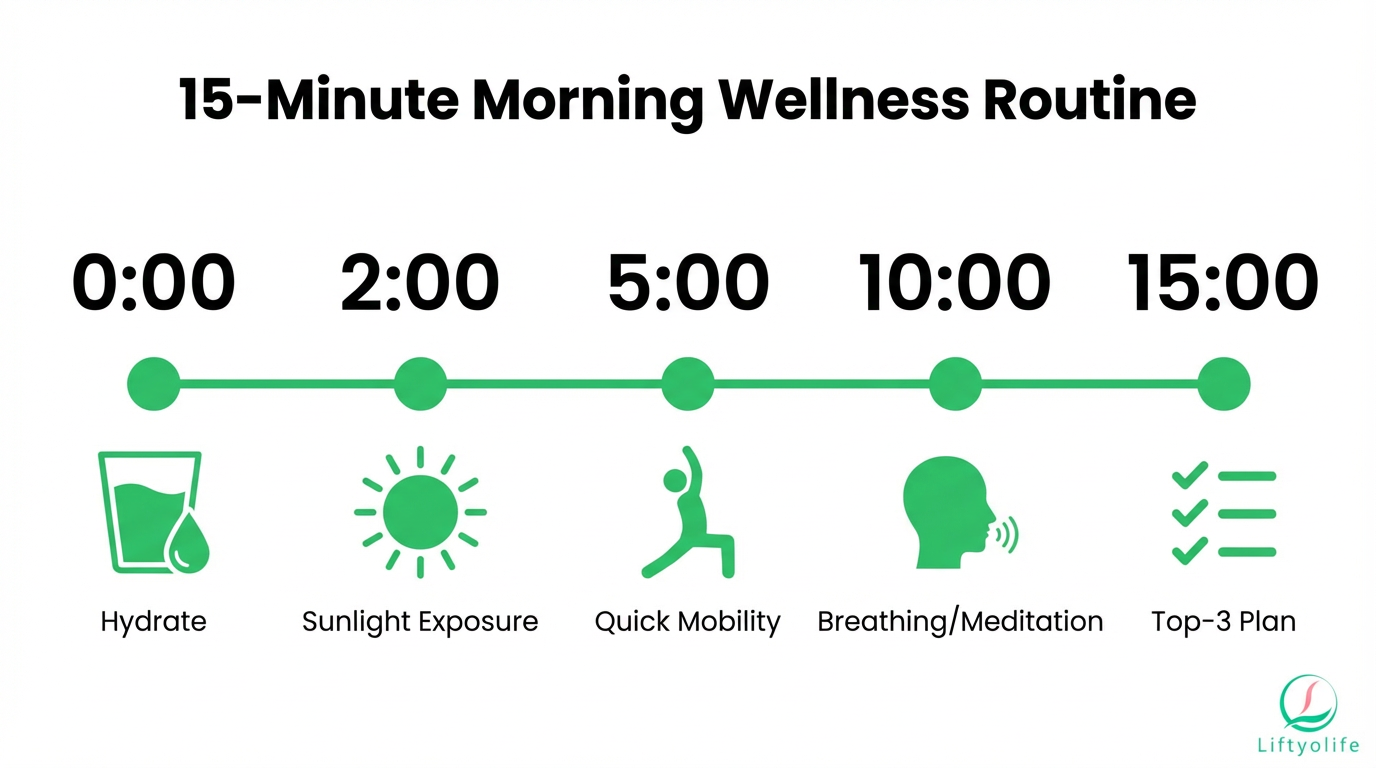
15-Minute Morning Wellness Routine (Balanced)
Time needed: 15 minutes
Steps (minute-by-minute):
- 0:00-2:00: Light + water (do both)
- 2:00-6:00: Gentle mobility (spine, hips, shoulders)
- 6:00-8:00: Breathing (box breathing, 4 rounds)
- 8:00-13:00: Short movement (walk or easy strength)
- 13:00-15:00: 3-minute plan (top 3 tasks)
Best for: most adults who want a 15 minute morning routine that boosts energy without requiring a full workout
Make it easier tomorrow: Put shoes and a jacket by the door so the walk is automatic.
30-Minute Morning Wellness Routine (Deeper Reset)
Time needed: 30 minutes
Steps (minute-by-minute):
- 0:00-5:00: Light + water + quick tidy
- 5:00-12:00: Mobility + gentle yoga flow
- 12:00-15:00: Breathing or a 3-minute meditation
- 15:00-25:00: Movement (walk, bike, or strength)
- 25:00-30:00: Breakfast prep (or pack a protein snack) + top-3 plan
Best for: stiff mornings, desk jobs, stressy seasons, anyone wanting a real morning self care routine
Make it easier tomorrow: Decide your movement the night before (route, video, or your 3 exercises).
60-Minute Morning Wellness Routine (Full Spectrum)
Time needed: 60 minutes
Steps (minute-by-minute):
- 0:00-10:00: Light + water + mobility
- 10:00-15:00: Breathing + 5-minute meditation
- 15:00-40:00: Workout (strength, cardio, or class)
- 40:00-55:00: Shower + reset your space
- 55:00-60:00: Breakfast + plan
Best for: people who like structure, want exercise plus real food, and use mornings as their main wellness window
Make it easier tomorrow: Prep workout clothes, plan breakfast ingredients, and queue your workout playlist.
Two Helpful Variations
Variation A: Workout-First
If you exercise best before eating, keep the start simple:
- Light + water
- 2 minutes mobility
- Workout
- Then breakfast with protein + carbs (for example, eggs + toast or yogurt + granola)
If you have knee or back issues, swap jumping for marching, step-ups, incline push-ups, or a stationary bike.
Variation B: No-Coffee / Caffeine-Sensitive
If coffee makes you jittery, anxious, or refluxy:
- Start with light, water, and 2 minutes of breathing
- Eat breakfast first (protein + fiber)
- Try tea (green, black, or herbal) or half-caff later
If you do use caffeine, many people prefer delaying it 60-90 minutes after waking so it does not stack on top of the natural cortisol rise. Keep it personal and pay attention to how you feel (FDA, NCBI).
Compare Your Options (Tables)
Use these tables to pick what fits today, not what looks impressive on paper.
| Time | Main focus | Core steps | Best for |
|---|---|---|---|
| 5 min | Anchor habits | Light, water, mobility | Late mornings |
| 15 min | Energy + calm | Light, hydrate, mobility, breath, plan | Most people |
| 30 min | Deeper reset | Add movement + breakfast prep | Stiff/stressed |
| 60 min | Full wellness | Workout, meal, plan | Self-care window |
A simple rule: if you are inconsistent, go shorter. If you are consistent, go longer.
| Movement choice | Intensity | Joint friendly | When to choose |
|---|---|---|---|
| Walk | Low | High | Sluggish, stiff |
| Mobility | Very low | High | Pain-free range work |
| Yoga flow | Low to moderate | Medium | Stress + flexibility |
| Strength (easy) | Moderate | Medium | Energy + confidence |
| Morning drink | What it is | Best for | Notes |
|---|---|---|---|
| Water | Plain fluid | Most mornings | Start here |
| Electrolytes | Water + minerals | Heavy sweat, heat | Optional, not required |
| Tea/coffee | Caffeinated drink | Alertness | Consider delay 60-90 min |
If caffeine makes you feel worse, adjust timing and dose before you blame your routine.
7 Mistakes That Make Morning Routines Fail
- Snooze loop – Put the alarm across the room and pick your wake time the night before.
- Phone-first mornings – Keep your phone on airplane mode for the first 10 minutes or charge it outside the bedroom.
- Overbuilding – Start with 3 steps. Add one step per week.
- Skipping light/movement and expecting energy – Do 2 minutes of light and 2 minutes of mobility, even on busy days.
- All-or-nothing thinking – Keep a “2-minute version” for late mornings.
- No night-before prep – Set out water, clothes, and one breakfast option.
- Using caffeine to replace sleep basics – Keep caffeine if you like it, but protect bedtime and a consistent wake time (CDC/NIOSH).
Safety Notes (Read This If You Have Health Conditions)
This article is educational, not medical advice. If you are managing a health condition or are unsure what is safe for you, check with a licensed clinician before making major changes to fasting, caffeine, or exercise.
- Diabetes or glucose-lowering meds: Fasting, skipping breakfast, and morning exercise can affect blood sugar. Consider eating earlier and monitor as advised.
- Low blood pressure (hypotension): Stand up slowly, be cautious with very hot showers, and avoid aggressive hydration challenges.
- Pregnancy: Choose gentle movement and avoid extreme heat or cold exposure. Ask your prenatal team about exercise intensity.
- Heart conditions or chest pain history: Get clearance before starting a new workout routine, especially vigorous exercise.
- Eating disorder history: Be cautious with rigid routines, fasting rules, or tracking that increases anxiety.
- Supplements/electrolytes: Optional, not required. If you take medications, ask about interactions.
Morning Wellness Routine Checklist (Screenshot This)
Minimum 3 for rushed mornings: light + water + 5 deep breaths (then 1 minute mobility if possible). You can also save this link to easily open the list and start a productive morning
Your Next 7 Days: A Simple Ramp-Up Plan
Use this ramp plan to build a quick morning routine that sticks without forcing yourself into a new personality overnight.
- Day 1: 5-minute minimum routine.
- Day 2: Repeat the same 5 minutes.
- Day 3: Add 5 minutes of movement (walk or easy yoga).
- Day 4: Repeat Day 3.
- Day 5: Add the 3-minute plan.
- Day 6: Add a protein + fiber breakfast option (or prep one for later).
- Day 7: Choose your default time template (5/15/30/60) and keep it for the next week.
2-minute night-before prep:
- Fill water bottle and set it out
- Put clothes/shoes where you will see them
- Decide breakfast (or a protein snack)
If you want more step-by-step wellness guides, Liftyolife has additional practical routines you can build on.
Jump back to Pick your time and commit to starting tomorrow.
Frequently Asked Questions
What’s the best morning wellness routine?
Start with hydration, light, and 2-5 minutes of movement. Add one mindset practice (breathing, meditation, or journaling). Finish with a simple plan (top 3 tasks) so your day feels directed.
What should I do first after waking up for wellness?
Drink water and get bright light (sunlight if possible). Avoid phone-scrolling for the first few minutes. If you wake up stiff, do gentle mobility first.
Should I exercise or meditate first in the morning?
If you feel anxious or rushed, do 1-3 minutes of breathing or meditation first. If you feel sluggish, do light movement first. The best order is the one you will repeat consistently.
Is coffee bad first thing in the morning?
Not “bad,” but many people feel better delaying caffeine 60-90 minutes. Hydrate first, and try food or protein before coffee if you get jitters. If you have reflux or anxiety, timing and amount matter more than coffee itself.
How do I build a morning routine I can actually stick to?
Start with a 5-minute minimum routine and keep it identical for 7 days. Attach it to a cue (after brushing teeth, before shower). Make it easy: set clothes, water, and your journal out the night before.
What if I wake up late—should I skip it?
Do the 2-minute version: water + light + 5 deep breaths. Then pick one non-negotiable (2-minute mobility or top-3 plan). Consistency beats perfection, so do not restart your day with guilt.
Sources, Updates, and Editorial Standards
Last updated
December 18, 2025
References
- Sleep Foundation: Circadian Rhythm – Plain-language circadian overview.
- National Center for Biotechnology Information (NCBI): Review on light and circadian rhythms – Mechanisms of light and body clock timing.
- CDC NIOSH: Work schedules and sleep – Sleep and performance considerations.
- FDA: Spilling the Beans, how much caffeine is too much? – General caffeine safety guidance.
Written by a wellness content specialist focused on behavior change and evidence-informed habits. Medical review: not yet completed.
A morning wellness routine works when it is short enough to repeat and structured enough to guide you. Start with light, water, and gentle movement, then add one mindset practice and a 3-minute plan as time allows. Choose a 5-60 minute template, run it for a week, and adjust based on what your mornings really look like.