
If you’re asking is 6 hours of sleep/day bad, you’re probably juggling a busy schedule, stress, or an early alarm and trying to figure out whether you can function well on less sleep. You’re not alone, and you’re not “lazy” for wanting a clear answer.
This guide gives you a verdict first, then a quick self-check, comparison tables, and a simple 7-day plan to move from sleep 6 hours a night toward a healthier range, plus when to talk to a doctor.
Quick Answer: Is 6 Hours of Sleep a Day Bad?
For most adults, 6 hours of sleep a day is below the recommended 7–9 hours, so it’s often not enough if it happens most nights. An occasional 6-hour night is usually fine, but chronic 6-hour sleep is linked to more daytime sleepiness and higher long-term health risks. A small number of people are true “natural short sleepers,” but they’re rare.
- Usually okay if… it’s occasional, you wake up refreshed, and your mood, focus, and energy are steady without heavy caffeine.
- Likely not okay if… you’re foggy, irritable, craving sugar, making more mistakes, or ever feel drowsy while driving.
- Do this next… use the self-check below for 2 weeks, then try the 7-day plan if you spot patterns.
How Much Sleep Do Most Adults Need?
Most adults do best with 7–9 hours of sleep per night. According to the American Academy of Sleep Medicine and Sleep Research Society, adults should get 7 or more hours regularly to support health and reduce risks associated with short sleep.
Also, sleep is best thought of as “per 24 hours.” Naps can count toward total sleep, but most people still feel and perform best with one consistent main sleep period at night because it supports your circadian rhythm and sleep schedule consistency.
Factors that can raise your sleep needs include:
- Hard training or physical jobs (more tissue recovery)
- High mental load (intense work, caregiving, studying)
- Illness or injury (immune and repair demands)
- High stress (more nighttime arousal and lighter sleep)
- Pregnancy and postpartum life (more fragmented rest)
- Chronic pain (lower sleep quality and more awakenings)
Is 6 Hours Enough If You Feel Fine?
It’s common to feel “fine” on 6 hours, especially if you’ve been doing it for a long time. The catch is that your brain can adapt to sleep loss so it feels normal, while performance still drops in quiet ways, like slower reaction time, lower patience, and more forgetfulness.
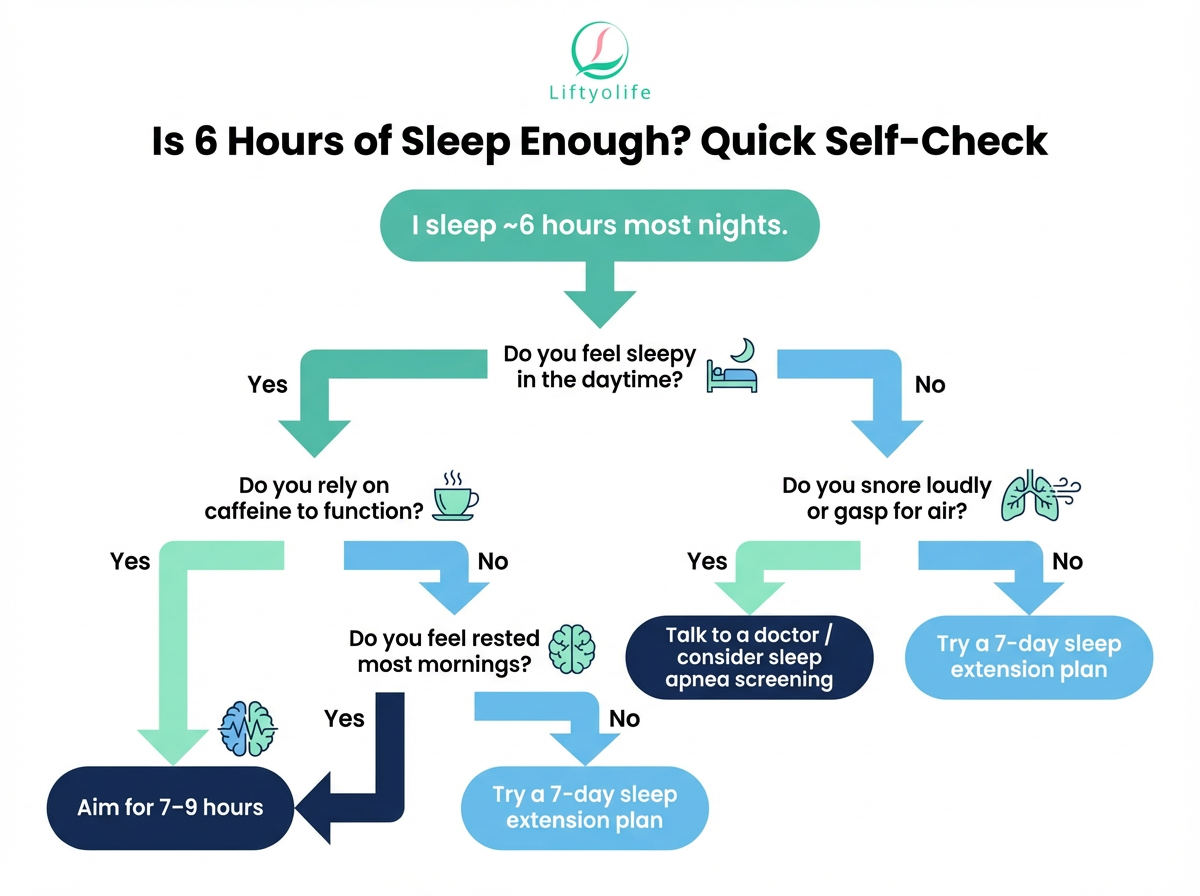
2-minute self-check: signs 6 hours isn’t enough
If you check 3 or more, treat it as a strong sign to try sleeping longer for one week and see what changes.
Extra red flags: loud snoring, gasping or choking at night, morning headaches, or high daytime sleepiness. Those can point to a sleep disorder even if you spend enough time in bed.
Long-Term Risks of Chronic 6-Hour Sleep
Long-term risk depends on consistency, your individual biology, and whether an underlying problem like sleep apnea is involved. But large research reviews and clinical consensus statements consistently find that regularly sleeping under 7 hours is associated with higher risks over time.
- Cardiometabolic health: linked with higher risk of weight gain, high blood pressure, type 2 diabetes, and cardiovascular disease.
- Immune function: associated with more frequent illness and slower recovery in some research.
- Mental health: linked to higher rates of depression symptoms, anxiety, and stress sensitivity.
- Cognitive health over time: associated with poorer attention and memory over years, especially with aging and stress.
The key point is that sleep is a leverage point. When people improve sleep duration and consistency, they often notice better energy and decision-making, which makes other health habits easier to follow.
Can You Catch Up on Sleep on Weekends?
Weekend catch-up sleep can help with short-term sleepiness, and some studies suggest modest catch-up sleep may partially offset risk in people who are sleep-deprived during the week. The downside is that large weekend sleep-ins can shift your body clock, making Sunday night harder and Monday morning rough.
| Helps with | Doesn’t fully fix |
|---|---|
| Short-term sleepiness | Circadian disruption |
| Some sleep debt | Sleep apnea risk |
| Mood for a day | Habitual 6-hour nights |
A better approach:
- Add 15–30 minutes on weeknights first.
- Keep your weekend wake time within about 1 hour of weekdays.
- Use a short nap (about 10–20 minutes) instead of a long sleep-in when you can.
Why You Might Be Stuck at 6 Hours
Many “6-hour sleepers” aren’t choosing it. They’re getting boxed in by habits, schedules, stress, or a treatable sleep issue.
Schedule and screens
If this sounds like you: set a “devices off” alarm 60 minutes before bed, and keep bedtime within a 30–60 minute range.
Stress, anxiety, and racing thoughts
If this sounds like you: do a 5-minute “brain dump” list (worries + tomorrow tasks), then a short wind-down (shower, stretch, book).
Caffeine timing
If this sounds like you: move caffeine earlier. Research shows caffeine can disrupt sleep even when consumed 6 hours before bedtime.
Alcohol close to bedtime
If this sounds like you: keep alcohol at least 3+ hours before bed, and notice whether you wake up more around 2–4 a.m.
Insomnia pattern (can’t fall asleep or can’t stay asleep)
If this sounds like you: keep wake time consistent, reduce time in bed awake, and consider CBT-I if it persists.
Possible obstructive sleep apnea (OSA)
If this sounds like you: loud snoring, gasping, or morning headaches plus daytime sleepiness are worth screening with a clinician.
For circadian rhythm support and morning light ideas, you can borrow steps from this morning wellness routine.
How to Go From 6 to 7+ Hours: 7-Day Plan
You don’t need a perfect routine to sleep longer. You need one steady wake time, a gradual bedtime shift, and fewer evening “sleep blockers” (light, caffeine, stress spirals).
- Day 1: Lock your wake time.
Pick one realistic wake time and keep it for 7 days (weekend included). - Day 2: Move bedtime 15 minutes earlier.
Do not change anything else yet. Just shift bedtime slightly. - Day 3: Get morning light.
Go outside within 1 hour of waking (walk, porch, or standing light exposure). - Day 4: Set a caffeine cutoff.
Aim for 6–8 hours before bed (earlier is better if you’re sensitive). - Day 5: Start a 30-minute wind-down.
Dim lights, lower stimulation, and pick one quiet routine: reading, stretching, breathing, or a warm shower. - Day 6: Fix the room, not your willpower.
Make the bedroom cool, dark, and quiet. Keep it for sleep and sex only. - Day 7: Add the second 15-minute shift (if sleep is coming easier).
If you’re falling asleep without a long struggle, move bedtime 15 minutes earlier again.
If you want a simple reminder you can save or screenshot, use the Liftyolife sleep checklist as your nightly cue.
If you wake up at night, use this mini-protocol
- Keep lights low, avoid the phone, and do a quiet activity (boring is good).
- If you’re awake about 20 minutes, get out of bed briefly, then return when sleepy.
- Write down “tomorrow tasks” so your brain stops rehearsing them at 3 a.m.
If insomnia is a recurring pattern for you, this guide on whether insomnia is genetic also covers common disruptors like screens, caffeine timing, and stress arousal.
When 6 Hours Could Signal a Sleep Problem
- Loud, frequent snoring
- Witnessed pauses in breathing, gasping, or choking
- Morning headaches, dry mouth, or waking unrefreshed despite time in bed
- High daytime sleepiness (dozing in meetings or while reading)
- Drowsy driving or near-miss accidents
- Insomnia lasting 3+ months or clearly affecting work, mood, or safety
If any of these fit, it’s worth talking to a clinician. They may use screening questions, check medical contributors, and sometimes order a home or in-lab sleep study. If insomnia is the main issue, CBT-I (cognitive behavioral therapy for insomnia) is a first-line, evidence-based approach that builds durable sleep skills rather than relying only on medication.
Bottom Line
- For most adults, is 6 hours of sleep bad? If it’s your normal routine, it’s often below the recommended 7–9 hour range.
- Occasional 6-hour nights are usually fine; chronic short sleep is where the tradeoffs show up.
- Use daytime function as your scoreboard: energy, mood, mistakes, cravings, and caffeine reliance.
- Reduce sleep debt by adding 15–30 minutes on weeknights before leaning on weekend catch-up.
- If you snore loudly, gasp, wake with headaches, or feel dangerously sleepy, get screened.
- Liftyolife aims to be a practical health guide, so you can take one small step tonight and build momentum.
Start tonight by moving bedtime 15 minutes earlier, then keep your wake time steady for the next 7 days.
A steady 7+ hours is usually where most adults notice better mood, sharper focus, and more stable energy. If 6 hours is unavoidable sometimes, focus on consistency, protect your mornings and evenings from the biggest sleep disruptors, and treat ongoing daytime sleepiness or snoring as a reason to get help.
Frequently Asked Questions
Is 6 hours of sleep enough for adults?
For most adults, no. Recommended sleep hours for adults are generally 7–9 hours, and 6 hours may be okay occasionally but often falls short if it’s your usual pattern. If you’re sleepy, moody, or leaning on caffeine, treat it as a cue to extend sleep.
Is 6 hours of sleep bad if I feel fine?
It can be. Many people adapt to feeling “normal” while performance still drops in subtle ways. Track your sleep and daytime function for two weeks (energy, mood, mistakes, caffeine), and consider screening if you snore loudly or wake unrefreshed.
Can you train yourself to need only 6 hours of sleep?
You can train yourself to tolerate it, but you may still be impaired. True natural short sleepers are rare. A safer approach is gradual sleep extension with a consistent wake time.
Can I catch up on sleep on weekends?
Catch-up sleep can reduce short-term sleepiness, and some research suggests modest catch-up may help people who are sleep-deprived during the week. But it doesn’t always erase the effects of schedule disruption. Try adding 15–30 minutes on weeknights and keeping weekend wake time close to normal.
Is 6 hours of sleep enough if I work out?
Often not. Training increases recovery needs, and many people perform and recover better with more sleep. Watch for declining performance, prolonged soreness, or low motivation, and prioritize consistent sleep.
What’s better: 6 hours at night plus naps or 7 hours straight?
A consolidated 7 hours straight is often better for consistency. Naps can help (especially for shift workers), but timing matters. Keep naps short (about 10–20 minutes) and earlier in the day so they don’t disrupt nighttime sleep.
References
- American Academy of Sleep Medicine: Seven or more hours of sleep per night is a health necessity for adults – Consensus statement linking <7 hours with health and safety risks.
- National Sleep Foundation: How much sleep do you really need? – Plain-language sleep duration recommendations by age group.
- CDC: Sleep and Sleep Disorders, Adults – Public health overview of adult sleep duration.
- European Society of Cardiology: Catching up on sleep on weekends may lower heart disease risk – Summary of cohort findings on weekend catch-up sleep.